

Almost everyone in Dubai has done this at least once felt something a bit off, shrugged, and kept going. A dull ache. A tiredness that lingers longer than it should. A headache tell yourself “isn’t that bad.” Between work, the commute, and the heat outside, it’s easy to push a symptom into the “I’ll deal with it later” pile and never actually get back to it. Most of the time, that’s genuinely fine. But not always — and figuring out which is which is really what this article is about.
Along the way, we’ll also clear up something people search for constantly but rarely get a straight answer on: what internal medicine actually means, and when it’s the specialist you should be calling instead of trying to guess between five different ones.
What Internal Medicine Actually Means
Internal Medicine is a medical specialist. That focuses on the health of adults. Internal Medicine specialists helps to prevent a wide range of adult health conditions. They look at your overall health to understand how different symptoms may be connected. These doctors are called Internal Medicine specialists. They are experienced doctors who are trained to care for adults with both common and complex health conditions.
Not every health issues has an clear cause or a clear specialist to consult. Many adult health issues are more complicated, while toothaches, skin conditions, and sports injuries usually require specific specialists. Symptoms such as ongoing fatigue, unexplained weight changes, recurring low-grade fever. In these situations, an Internal Medicine specialist is often the right place to start. They take a comprensive approach by evaluating your overall health, finding the reason of your symptoms, recommending the proper blood tests or imaging where necessary, and referring you to another specialist only if further specialized care is necessary.
- Taking care of chronic illnesses like diabetes, high blood pressure, thyroid issues, and high cholesterol
- These symptoms that don’t indicate anything visible, such as persistent low-grade fever, weight fluctuations, and weariness that won’t go away
- Keeping your care joined up, so you’re not bouncing between specialists trying to piece it together yourself
- A proper adult check-up, even if you feel completely fine right now
Why Certain Symptoms Deserve More Than a Shrug
Most of what your body throws at you day to day is just noise. A headache after a long day of screens. Stiffness from sitting in traffic. Feeling drained after a bad night’s sleep. All ordinary, all things that pass on their own.
Every now and then, though, a symptom that looks just as harmless turns out to be the earliest sign of something far more serious. What makes this tricky is that serious conditions rarely announce themselves. A heart attack can feel a lot like indigestion. A brain tumour can start out as “just a headache I keep getting.” Early-stage diabetes, for a lot of people, causes almost nothing noticeable at all.
That’s why the instinct to “wait and see if it gets worse” is often exactly what costs people the window where treatment is easiest and most effective. This isn’t meant to alarm anyone — it’s simply how most serious adult illness tends to behave, whether we’re talking about heart disease, cancer, or metabolic conditions. It’s also the entire reason internal medicine exists as a specialty: to spot that pattern before it becomes an emergency.
ER or Clinic? Where the Line Actually Sits
- Chest pain or pressure that spreads into your arm, jaw, neck, or back — have someone drive you, or call for help, don’t get behind the wheel yourself
- A sudden, brutal headache unlike anything you’ve felt before — treat it as an emergency unless a doctor tells you otherwise
- Sudden weakness or numbness on one side of the body, slurred speech, or a sudden loss of vision — classic warning signs of stroke
- Breathing difficulty that appears out of nowhere, with nothing to explain it
- Fainting, severe confusion, or not responding to people around you
“A Patient I’ll Always Remember
One of the patients I remember is a middle-aged man who came to me after a few weeks of exceptionally high levels of exhaustion, which he thought were only caused by stress at work and a busy schedule.
we discussed his overall health during our conversation. He had Type 2 diabetes, according to the results of a thorough evaluation and blood tests. His heart, kidneys, and eyes were not among the major organs afflicted by the condition when it was first discovered.
Such an experience made me realize that most health issues do not occur due to noticeable symptoms. They actually come about as a result of a very common thing such as tiredness. It is only by seeking professional advice that we can be able to know what causes these issues and treat them.”
Serious Symptoms in Adults, Grouped by What’s Going On

Heart and Circulation
Chest pain
A heavy, crushing sensation in the chest particularly one spreading down the left arm or up into the jaw is a genuine warning sign, more so if it’s accompanied by sweating, nausea, or shortness of breath. Plenty of chest pain does turn out to be reflux, a strained muscle, or anxiety. But that’s not a call to make from your sofa. Get it checked rather than sit with it.
Legs swelling with no obvious cause
If your ankles or lower legs are puffing up and it isn’t from a long day standing or a minor knock, it’s worth investigating. Heart problems, kidney issues, blood clots, and thyroid conditions can all show up this way. One leg swelling suddenly on its own is a particular flag for a clot.
Neurological
Headache
A headache that begins suddenly and becomes extremely severe within seconds or minutes is known as a thunderclap headache. Unlike more common headaches that develop gradually, this type of headache may indicate a serious medical condition, including bleeding around the brain or meningitis.
Sudden confusion and memory gaps
Especially alongside slurred speech or one-sided weakness can point to a stroke, a mini-stroke (TIA), or a brain injury, and it calls for urgent attention rather than a wait-and-watch approach.
Breathing
Getting breathless without a clear reason
while resting, doing very little, or waking you up at night and shouldn’t be dismissed. Causes range from anaemia and asthma to heart failure and pulmonary embolism. If it turns up alongside chest discomfort, swollen legs, or a cough that won’t quit, that combination raises the concern further.
Stomach and Digestion
Severe abdominal pain
This is your body’s way of flagging something urgent to appendicitis, gallbladder trouble, a bowel blockage, kidney stones, or a perforated ulcer can all present this way. If it comes with fever, vomiting, or a belly that’s rigid and tender, that’s an emergency rather than something to wait out.
Blood showing up
Somewhere it shouldn’t in the stool (bright red or dark and tarry), in urine, unexpected bleeding after menopause, or bruising with no clear cause always warrants a doctor’s attention. Sometimes it’s minor. Sometimes it’s not. Testing is the only way to know which.
Hormones and Metabolism
Weight Loss
If your weight continues keeps dropping over weeks or months, and nothing’s changed about how you eat or move, that’s worth looking into. It shows up alongside undiagnosed diabetes, an overactive thyroid, some cancers, gut inflammation, and even depression. it’s a signal.
Tiredness
You’re getting decent sleep and still dragging through the day, week after week, to the point it’s affecting how you function, the possible causes span a wide range: low iron, thyroid trouble, sleep apnoea, diabetes, a lingering infection, autoimmune conditions. A blood test and a proper check-up usually narrows it down quickly, and catching the right cause early can genuinely change how you feel from day to day.
Head to the ER immediately if abdominal pain comes with:
- Sudden, severe, or rapidly worsening pain
- A belly that feels rigid or hard to the touch
- Fever alongside the pain
- Repeated vomiting, or vomiting blood
- Inability to pass gas or stool, combined with bloating and pain
- Pain spreading to the back, shoulder, or chest
- Feeling faint, a racing heart, or cold, clammy skin
Book a clinic visit instead if the pain is:
- Mild to moderate, comes and goes, and seems tied to food or stress
- Been around for more than a week with no obvious trigger
- Paired with unplanned weight loss, blood in the stool, or ongoing bloating
- Following a pattern — after meals, at night, or alongside changes in bowel habits
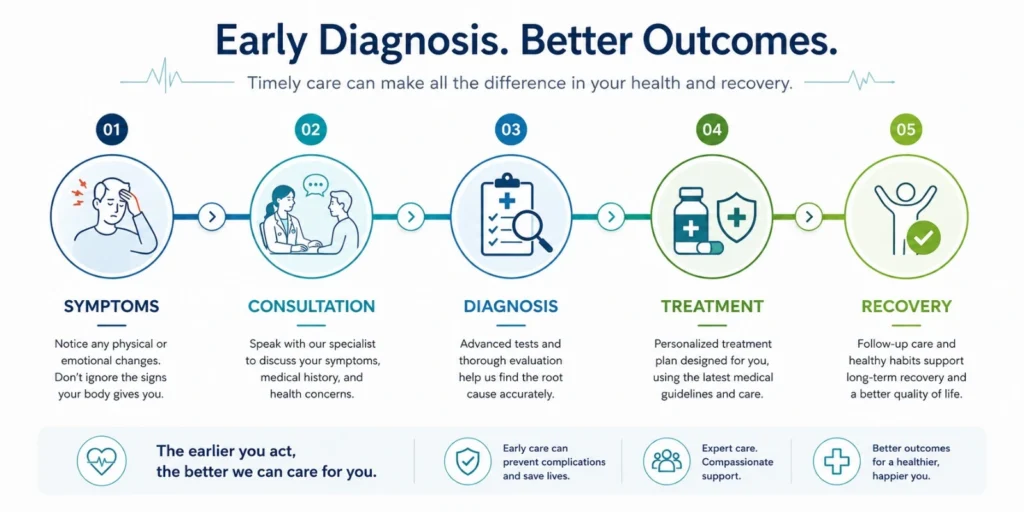
The list of possible causes spans a huge range in urgency. Appendicitis, gallstones, a bowel blockage, kidney stones, and a perforated ulcer need surgery, quickly. Reflux, IBS, and mild gastritis don’t. The pain itself won’t tell you which category you’re dealing with — the pattern, what comes with it, and an actual physical exam will. That’s exactly the job of an internist: figuring out whether you need a surgeon, a gut specialist, or simply reassurance and a plan.
FAQ
It’s the branch of adult medicine that treats the body as a whole rather than one organ at a time. The doctor who practices it is called an internist.
Ongoing tiredness that rest doesn’t fix, weight change you can’t explain, a low fever that keeps coming back, digestive changes that persist, or, honestly, anything that’s felt off for more than a couple of weeks, even without anything dramatic attached to it.
Chest pain, a sudden severe headache, unexplained weight loss, unusual bleeding, breathlessness at rest, sudden confusion or vision changes, and a persistent high fever. None of these are worth sitting on.